0:33, silent. Watch it with music on Instagram.
The circle of Willis: textbook vs a real brain
The circle of Willis in one real brain, rebuilt in 3D. Then the textbook ring you learned, and what differs.
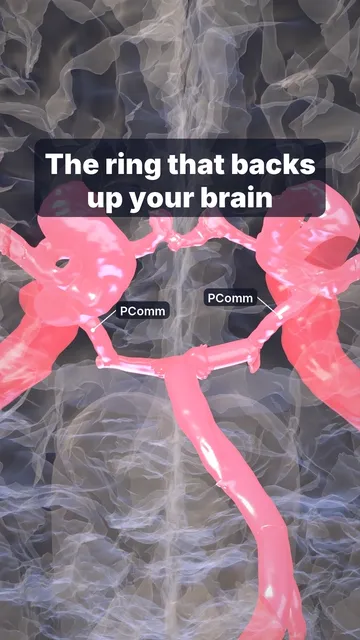
- First his whole arterial tree, from the carotid and vertebral arteries in the neck up, traced from a 0.15 mm angiogram of one healthy volunteer. At the base of the brain: the circle of Willis.
- The textbook ring: a complete, symmetric loop of arteries under the brain. Both carotids (ICA) and the basilar artery feed it, joined by the anterior communicating artery (AComm) at the front and the two posterior communicating arteries (PComm) at the back.
- In this volunteer the front half matches the textbook: both A1 segments and the AComm.
- At the back, both PComms are thin: barely visible on his angiogram, the left one clearly under 1 mm.
- That is the most common variant: at least one thin or missing PComm in about 4 in 10 people. The full textbook circle, with no thin or missing segment, is found in only about 1 in 3 (meta-analysis of 33 studies).
- A variant, not a disease. It only matters if a main artery narrows or blocks.
- Clinical: the ring is a backup route. If a carotid blocks, blood from the other carotid (through the AComm) and from the basilar (through the PComms) can still reach that side. And most brain aneurysms (about 85%) form on this ring and its first branches.
Sources and licence
Numbers depend on the method: MR angiography misses vessels thinner than ~1 mm, so imaging studies find fewer complete circles than dissection. Data: the 7 T time-of-flight angiogram (0.15 mm voxels) of one healthy volunteer (Lüsebrink et al., Sci Data 2021, CC0), arteries segmented by us; the textbook ring is our symmetric drawing of his ring. Facts: Jones et al., Clin Anat 2021; Hindenes et al., PLoS ONE 2020; Krabbe-Hartkamp et al., Radiology 1998; StatPearls (circle of Willis); Henderson et al., Stroke 2000; Keedy 2006.
Video licence: CC BY 4.0. To reuse it, credit “Cerebrarium (Aldo Spolaore)”, link to this page and name the data sources above.
Educational content, not medical advice.