0:36, silent. Watch it with music on Instagram.
How your brain says STOP: the indirect pathway
The indirect pathway, step by step: how the basal ganglia hold back the movements you don't want.
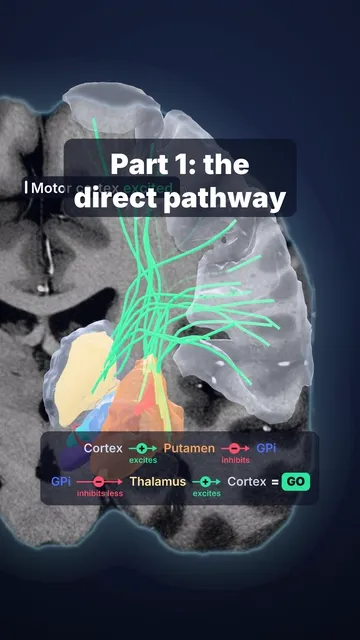
Recap: at rest the GPi inhibits the motor thalamus; the direct pathway (part 1) releases it.
The indirect pathway, step by step:
- The motor cortex excites the putamen (D2 neurons).
- The putamen inhibits the GPe.
- The GPe inhibits the STN less: the STN is released.
- The STN excites the GPi (the only excitatory nucleus in the loop).
- The GPi inhibits the thalamus more.
- The thalamus excites the motor cortex less → the movements you don't want are held back (STOP).
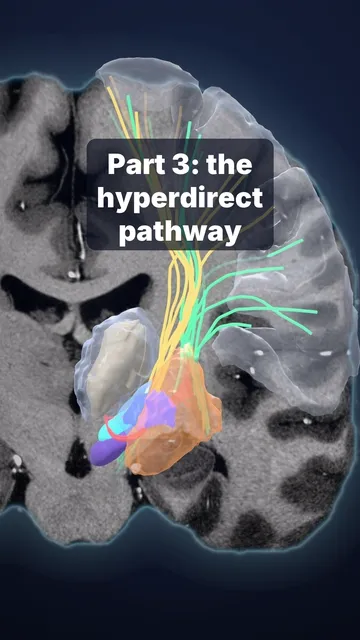
The route: the GPe → STN fibres cross the internal capsule in the subthalamic fasciculus; the STN → GPi fibres cross back.
Huntington's disease: the putamen neurons of the indirect pathway (the ones that inhibit the GPe) are lost first, even before symptoms. The brake gets weak → unwanted, dance-like movements (chorea). Dopamine inhibits this pathway through D2 receptors, so in Parkinson's it becomes too strong.
Sources and licence
Data: 7 T MRI of one volunteer (Lüsebrink et al., Sci Data 2021, CC0); pallidum split, STN: MASSP 2.0 (CC BY 4.0); VA/VL: Allen Human Reference Atlas 3D (CC BY 4.0); corticostriatal and thalamocortical fibres: HCP1065 tractography atlas (Yeh 2022, CC BY-SA 4.0). The striatopallidal, subthalamic and pallidothalamic fibres are drawn by us along published routes (Gallay 2008; Haber 2016). Green = excites, red = inhibits. Simplified textbook (rate) model.
Video licence: CC BY-SA 4.0. To reuse it, credit “Cerebrarium (Aldo Spolaore)”, link to this page and name the data sources above.
Educational content, not medical advice.